
Troubleshooting
Run /ca:doctor in Claude Code or $ca-doctor in Codex when codeArbiter is not behaving as
expected. The command is a read-only health check over interpreter, payload, cache, activation, and
live-fire enforcement. Claude also checks statusline wiring. Codex instead requires its hook set to
be trusted through /hooks; start a fresh thread after approving a changed set.
Run the Check
Section titled “Run the Check”Open the project where the problem appears and run the host-native command:
/ca:doctor$ca-doctorDoctor prints a result for each check and exits 0 if all pass, non-zero otherwise. Fix failures in the order reported: later failures are often downstream of the first.
What Doctor Checks
Section titled “What Doctor Checks”Interpreter Health
Section titled “Interpreter Health”Doctor confirms that at least one Python interpreter resolves. codeArbiter registers every hook twice in hooks.json: once under python3, and once under a python3 -c "" || python fallback. On a stock Windows machine with only python on PATH, the fallback fires and the gates still run. If neither name resolves, doctor warns loudly: the gates are dormant and no enforcement is active.
Interpreter failure is the most common cause of a silent install.
To fix: add Python 3 to PATH. Verify outside Claude Code with python3 --version or python --version. At least one must succeed.
Payload Integrity
Section titled “Payload Integrity”Doctor checks that the plugin payload is internally consistent and all expected files are present.
To fix: if integrity fails, reinstall or update the plugin.
Stale-Cache Detection
Section titled “Stale-Cache Detection”Cached payload data and settings paths can lag behind a plugin update. Doctor detects outdated entries and reports which ones are stale.
To fix: run /ca:doctor after every plugin update and follow the remediation it prints.
Repo Activation
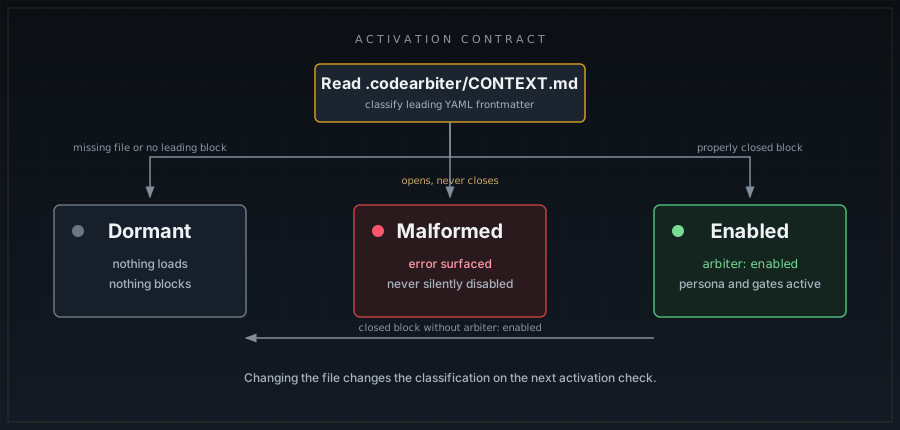
Section titled “Repo Activation”Doctor reads .codearbiter/CONTEXT.md and checks three things:
- The file exists at the repo root.
- The leading YAML frontmatter opens with
---on line 1 and closes with a second---. - The closed block contains
arbiter: enabled.
A repo without the file is dormant: the gates do not fire and no orchestrator persona is injected. An unclosed frontmatter block surfaces as a malformed-state error rather than silently treating the repo as disabled.
To fix: confirm the first three lines of .codearbiter/CONTEXT.md read:
---arbiter: enabled---If the file is absent, run /ca:init to scaffold it.
Live-Fire Hook Probe
Section titled “Live-Fire Hook Probe”Doctor runs a hook invocation to confirm a hook binary actually executes end-to-end, not just that an interpreter binary is on PATH. A passing interpreter check alongside a failing probe points to a registration or permissions problem with the hook files themselves.
To fix: reinstall the plugin to repair hook registration.
Statusline Wiring
Section titled “Statusline Wiring”Claude Code only. Codex has no statusline surface; do not treat that absence as a failed check.
Doctor checks that the statusLine.command entry in ~/.claude/settings.json points to the current version of statusline.py. The stored path is absolute and version-pinned, so a plugin update can leave it pointing at the previous version. The SessionStart hook repairs this automatically each session, but doctor will report a stale wire before the first post-update session runs.
To fix: run /ca:statusline to re-wire explicitly, or open a new Claude Code session to trigger the automatic repair.
ca-pi currently ships as a Feature Forge preview. Real use and feedback are
welcome; reports from live repositories help it graduate.
On Pi, run /ca-doctor first — it is the diagnostic entry point, checking the active package path,
canonical Pi CLI and package origin, command ownership, supported-version fingerprints,
Python/core/bridge health, child fingerprint, final mutator wrappers, and the H-03 wrapper
self-test.
Pi has several distinct silent-inactivity states that look alike but have different fixes:
| Symptom | Likely cause | Fix |
|---|---|---|
| Nothing enforces, no orchestrator persona | .codearbiter/CONTEXT.md missing or arbiter: enabled not set | Run /ca-init, per Repo Activation above |
| Repo is enabled but still dormant | Pi project trust not granted | Grant Pi project trust for the repo, then start a fresh session |
| Trust was just granted but still dormant | Trust was granted in the current session, not a fresh one | Start a new session after granting trust — the parent registers repository-aware dispatch only on a fresh session that reports the trust decision |
| Mutating calls fail, or an interpreter breadcrumb appears | Python 3 not on PATH | Add Python 3 to PATH; ca-pi blocks mutating calls rather than failing silently when the interpreter is missing |
/ca-<name> doesn’t do anything | Wrong invocation syntax | Pi uses /ca-<name> generated aliases with /skill:ca-<name> as the host-native fallback — this differs from Codex’s $ca-<name> convention |
| Doctor reports an unsupported version | Pi CLI is not 0.80.5 or 0.80.10 | Upgrade to Pi 0.80.5 or Pi 0.80.10, the only supported versions in this release line; see Compatibility |
Symptom Reference
Section titled “Symptom Reference”| Symptom | Likely cause | Suggested check |
|---|---|---|
| Gates don’t fire in any repo | python3 and python both absent from PATH | Doctor’s interpreter section; verify with python --version in a shell |
| Gates don’t fire in one specific repo | arbiter: enabled missing or frontmatter unclosed | Doctor’s repo activation section; inspect .codearbiter/CONTEXT.md |
| Orchestrator persona not loading | Repo not opted in; SessionStart finds no activation flag | Doctor’s repo activation section; run /ca:init if the file is absent |
| Stale behavior after a plugin update | Cached payload or statusline path is outdated | Doctor’s stale-cache and statusline sections |
| Statusline shows wrong stage or stale data | Statusline wired to previous statusline.py path | Doctor’s statusline section; run /ca:statusline to re-wire |
| Malformed-state error on session start | Frontmatter opens with --- but never closes | Inspect .codearbiter/CONTEXT.md line 2 for the closing --- |
| Merged PR but task still open on board | Merged-but-not-flipped task | Doctor runs a read-only reconciliation sweep and reports any such tasks |
Related
Section titled “Related”- Enforcement and Security for the activation contract and dual-interpreter registration
- Hooks reference for per-hook behavior and fail postures that doctor inspects
- doctor command reference for the full command description