
Record an Architecture Decision
Record an Architecture Decision Record (ADR) when a choice is significant enough to constrain future work: a data-store selection, a dependency commitment, a structural boundary, or a security posture. This guide walks through authoring, superseding, and monitoring ADRs.
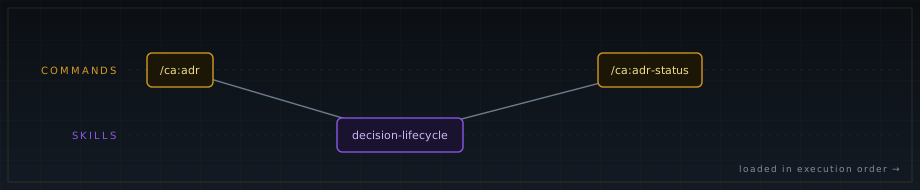
/ca:adr lane by piece type: commands (gold) and the skill that backs them (violet), each loaded in execution order.Before You Start
Section titled “Before You Start”Confirm codeArbiter is active. The first three lines of .codearbiter/CONTEXT.md must include arbiter: enabled inside a closed frontmatter block. If it does not, run /ca:init first.
Run /ca:adr
Section titled “Run /ca:adr”Invoke the command with a short description of the decision:
/ca:adr "Use PostgreSQL as the primary datastore"The decision-lifecycle skill opens an interview. It asks for the context that made this decision necessary, the options you considered, the rationale behind the choice, and any consequences or constraints it carries. The skill writes nothing until you have supplied that information. Every field in the record is your input, not a generated judgment.
What the Skill Produces
Section titled “What the Skill Produces”/ca:adr writes a numbered, dated, user-attributed file to .codearbiter/decisions/. Files follow the sequence already in that directory: ADR-0001.md, ADR-0002.md, and so on. The author: field names you. codeArbiter never fills in that field with its own identity.
H-11 makes that requirement durable. Shell operations that write directly to decisions/ are blocked at the tool-call boundary: redirects, cp, rm, and sed -i targeting that directory all exit non-zero. Direct Write and Edit calls to files there are blocked the same way. The skill drops a fresh authoring marker before it writes; any write attempt without that marker is rejected. There is no path to create or modify an ADR outside of /ca:adr.
Supersede an Outdated Decision
Section titled “Supersede an Outdated Decision”When a new decision replaces an earlier one, run /ca:adr again and tell the skill which ADR the new one supersedes. The skill marks the earlier ADR’s status as superseded and links the two records in both directions. The original file stays intact; the chain shows which decision is current.
Check Decision Health
Section titled “Check Decision Health”/ca:adr-statusThis command sweeps .codearbiter/decisions/ and reports:
- ADRs that are aging without challenge
- records with unresolved
CONFIRM-NNmarkers - decisions that are candidates for supersession
/ca:adr-status is read-only. It surfaces information and never writes. Act on its output by running /ca:adr.
Related
Section titled “Related”- adr command reference
- adr-status command reference
- decision-lifecycle skill reference
- Enforcement (H-11: ADR authoring gate)