
Enforcement & Security
codeArbiter’s gates are not advice the model can talk past. They run as Claude Code or Codex
hooks at the tool-call boundary, in Python, with no third-party dependencies.
Both plugins vendor the same guard core. Claude Code receives its exit-2 verdict directly; Codex’s
pre-tool-adapter.py converts the same verdict to a structured deny response so Windows shell exit
handling cannot weaken the block. See the
Claude Code + Codex evidence.
For the per-hook breakdown, see the Hooks reference.
The Activation Contract
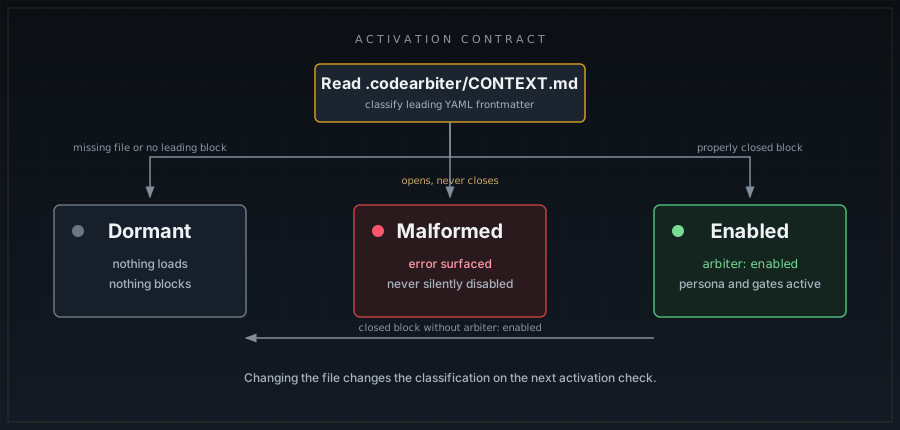
Section titled “The Activation Contract”codeArbiter is dormant until a repository opts in. Every enforcement hook calls arbiter_active(), which is true only when .codearbiter/CONTEXT.md carries arbiter: enabled in a properly closed leading YAML frontmatter block. A repo with no such file, or no such line, loads nothing and blocks nothing.
- Opt-in by file, not by install. Installing the plugin does not enforce anything. Enforcement begins the moment
CONTEXT.mddeclares the repo enabled. - Persona injection. On an enabled repo, the
SessionStarthook injects the orchestrator persona. That single file is the only always-loaded context. - Malformed frontmatter fails loud. A frontmatter block that opens (
---on line 1) but never closes is surfaced as a malformed-state error, not silently treated as disabled. A file with no frontmatter at all is simply dormant.
Blocking Commit-Time Gates
Section titled “Blocking Commit-Time Gates”These run in pre-bash.py on PreToolUse(Bash|PowerShell) (plus the Write/Edit guards for the audit trail and ADRs). Each blocks the tool call outright. Ambiguity resolves closed: a spelling that cannot be told apart from a destructive one is blocked, and /ca:override is the sanctioned escape hatch.
| Gate | Enforces |
|---|---|
| H-01 | No direct commit or push to the default branch. Covers main/master case-insensitively, a detached HEAD sitting on a protected branch’s tip (the commit still lands on that history), and protected refspecs (HEAD:main, feature:main, :main deletion, refs/heads/main), plus --all/--mirror bulk pushes that publish every ref. |
| H-02 | No force-push, in any spelling: --force, --force-with-lease, --force-if-includes, bare -f, or a forcing +refspec. |
| H-03 | No wildcard staging. Blocks the flag forms (-A, --all, -u, .) and the argument forms (globs, directories, pathspec magic). Staging must name files. |
| H-05 | Append-only audit logs (overrides.log, triage.log, sprint-log.md). Shell truncation/rewrite verbs aimed at a log are blocked; the Write/Edit flank blocks overwrites, an empty-old_string Edit (not a verifiable append), and MultiEdit on a log. |
| H-09b / H-10b | Crypto and secret commit gate. A commit that introduces a crypto/TLS or secret line is blocked unless the crypto-compliance / secret-handling gate has recorded a pass for those exact lines. |
| H-11 | ADRs are authored only via /ca:adr. Both the shell flank (redirects, cp, rm, sed -i into decisions/) and the Write/Edit flank are guarded; the skill drops a fresh authoring marker first. |
| H-14 | Migration review. A commit staging a database migration is blocked unless a migration-review pass is recorded for that file’s current content. |
H-09b/H-10b is digest-bound: a recorded pass covers only the exact sensitive lines it approved, which closes a time-of-check / time-of-use gap between approval and commit. The board-sync behavior implied by the commit gate (only /ca:task writes open-tasks.md) follows from ADR-0008. For the design rationale behind both, see Hardening History.
Advisory, Non-Blocking Reminders
Section titled “Advisory, Non-Blocking Reminders”post-write-edit.py (PostToolUse(Write|Edit)) surfaces reminders right after a write. These never block. They nudge so the blocking gate is not a surprise at commit time.
- H-09 / H-10: crypto/TLS or secret pattern touched. Run the gate now; the commit will block until a pass is recorded.
- H-12: the file is governed by an accepted ADR (
governs:glob). Route to/ca:reconcileor/ca:adrrather than drift. - H-15: CI/CD workflow changed. Dispatch
security-reviewerbefore the PR merges. - H-16: deployment / IaC manifest changed. Same.
- H-17: authentication/authorization logic touched (narrow, high-signal patterns only).
- Plus H-07 (dependency manifest changed) and an anti-slop prose check on user-facing docs.
These are advisory because they bite at a later boundary, not at commit. A bad CI workflow, IaC manifest, or auth change does damage only once merged or applied, and security-reviewer is the real enforcement point at the PR. The dangerous crypto and secret primitives, which land the moment code ships, stay hard-blocked by H-09b/H-10b.
Sandbox Isolation for Untrusted Repositories
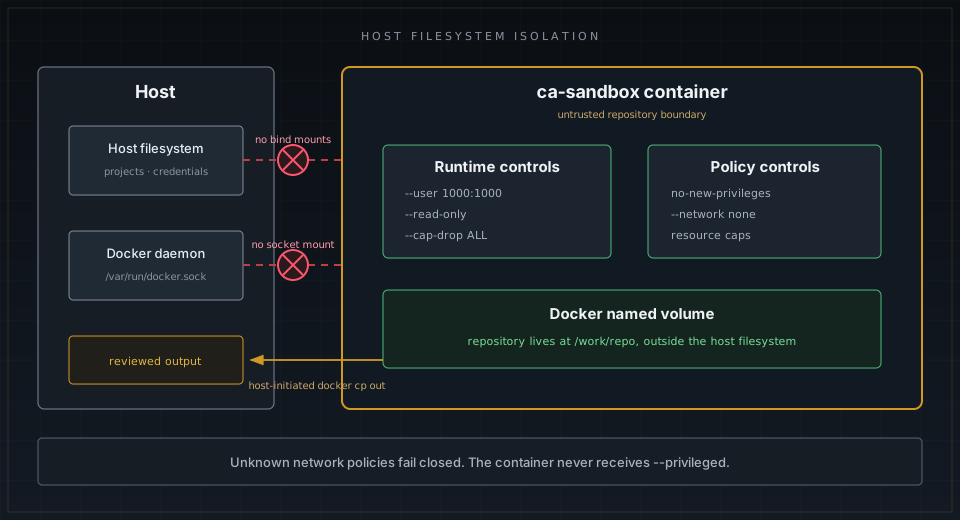
Section titled “Sandbox Isolation for Untrusted Repositories”codeArbiter runs untrusted repositories inside ca-sandbox, isolated as non-root (--user 1000:1000), with a --read-only root, --cap-drop ALL, --security-opt no-new-privileges, and a fail-closed network policy (default --network none; an unknown policy is a hard error, not a silent pass-through). No host bind mounts; the docker socket is never mounted. For how this posture evolved release over release, see Hardening History.
Pi: Project Trust and Child Processes
Section titled “Pi: Project Trust and Child Processes”The complete ca-pi adapter currently ships as a Feature Forge preview.
Real use and feedback are welcome while broader testing continues before
stable status or a claim of 100% validation.
Pi’s activation contract is the same arbiter: enabled flag as Claude Code and Codex, plus one
addition: an enabled repository still requires Pi’s own affirmative project-trust decision before
repository-aware startup. The parent registers repository-aware dispatch, farm preview, and native
compaction only after the current session reports that trust, the repository is enabled, and the
enforcement lifecycle is ready. A session opened before trust is granted, or before the repo opted
in, stays inert — nothing repository-aware runs.
codearbiter_dispatch and codearbiter_farm_preview are parent-only EXEC tools. A child
process spawned to do author or reviewer work cannot escalate itself into repository-aware dispatch
or farm access. Ordinary child/subagent environments never receive FARM_API_KEY or other
governance secrets; that key is scoped to the trusted parent only.
Run /ca-doctor to verify this is actually live: it inspects the active package path, command
ownership, Python/core/bridge health, child fingerprint, and the H-03 wrapper self-test. Its
module-identity check proves self-consistency between the operator-launched Pi CLI, imported module,
package root, and reported version — it does not prove publisher authenticity. Verify the
installed source separately with pi list and pi config.
Fail-Loud, Never Silently Dormant
Section titled “Fail-Loud, Never Silently Dormant”The hooks fail loud: a blocking gate prints BLOCKED [H-NN]: … to stderr and exits 2. The one deliberate fail-open is hook-input parsing. A malformed stdin must not brick the session by blocking every subsequent tool call (documented in _hooklib.read_input()).
Enforcement is resilient to host interpreter conventions. Claude Code carries its tested
interpreter fallback. Codex registers one OS-specific command per event (python3 on POSIX,
python on Windows), avoiding concurrent handlers with conflicting results.