
Claude Code + Codex
Shared enforcement and project-context parity across Claude Code and Codex
Section titled “Shared enforcement and project-context parity across Claude Code and Codex”Documentation launch: 2026-07-12. This page announces the verified 2026-07-11 Codex support result while retaining the public-marketplace smoke test as a release gate.
Of codeArbiter’s four sibling plugins, this page covers two: ca for Claude Code and ca-codex for
OpenAI Codex (see Pi for the third governance host, currently a Feature Forge
preview with real use and feedback welcome, and
ca-sandbox for the non-governance infrastructure plugin). Both activate from
the same .codearbiter/CONTEXT.md, enforce the same project rules, and read and write the same
checked-in .codearbiter/ state. One person can alternate between hosts, or two people can use
different hosts in the same repository, without creating parallel governance state.
Parity here has a precise boundary. The enforcement decisions and project context are shared. The host interfaces are not identical, and this page lists those intentional differences rather than hiding them behind a broader claim.
Verified live on 2026-07-11
Section titled “Verified live on 2026-07-11”The promotion test ran on Windows with Codex CLI 0.144.1 and ca-codex 0.2.4. This is a dated verification record, not a promise that future doctor versions will always contain the same number of checks.
| Check | Observed result |
|---|---|
| Hook review | The ca-codex hook set was reviewed and trusted through /hooks. |
| Session activation | The SessionStart hook completed and injected the codeArbiter persona and startup state. |
| Static doctor | $ca-doctor reported 9 OK, 0 WARN, 0 FAIL for that verification run. |
| Live enforcement | The doctor probe attempted git add --all --dry-run; PreToolUse blocked it with [H-03] and surfaced the exact feedback. |
The detailed repository ledger is docs/parity.md.
The reproducible live procedure is
docs/codex-parity-testing.md.
Those files remain the canonical technical record; this page is the public summary.
Verified continuously
Section titled “Verified continuously”CI and local verification cover the seams that a one-time live run cannot:
- the pinned Codex 0.144.1 package schema and marketplace shape;
- native Codex payload adaptation for shell and
apply_patchtool calls; - the complete hook guard matrix;
- Windows, macOS, and Linux interpreter-launch shapes through the cold-install matrix;
- deterministic generation of both host surfaces from
core/surface/; - byte-identical vendoring of the shared Python hook core into both plugins;
- dual-host initialization against one store; and
- controlled concurrent append-only audit writes with host attribution and no lost records.
The live and CI evidence complement each other. CI proves deterministic parity for equivalent payloads; the live run proves Codex actually discovers, trusts, invokes, and honors the installed hooks.
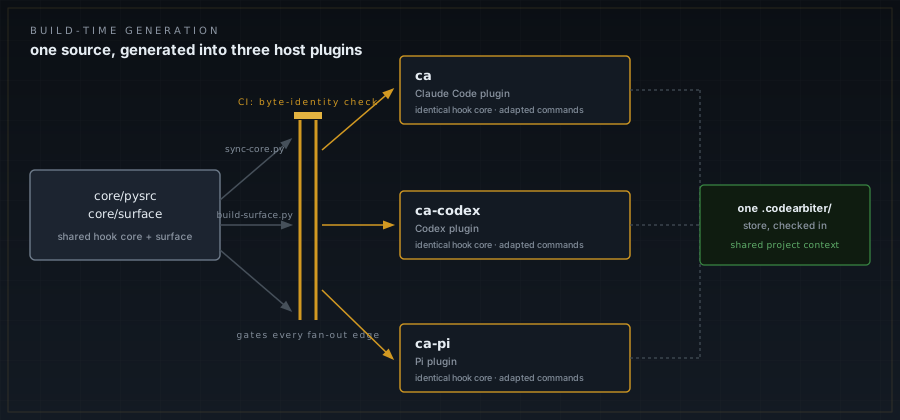
Use one repository from either host
Section titled “Use one repository from either host”Commit .codearbiter/ with the repository. It contains project context, plans, decisions, task and
question boards, and append-only audit records. Neither plugin copies that state into a host-owned
directory.
When Claude Code and Codex open the same checkout, they see the same maturity stage, open work, ADRs, and audit history. A second user on another checkout receives that state through normal Git collaboration. Initialization is idempotent: the second host observes the existing store instead of creating another one.
Same checkout, same time
Section titled “Same checkout, same time”The parity claims above cover alternating hosts or different checkouts. Two people driving Claude Code and Codex against the same working tree at the same time are a narrower case, and the supported bar for it is ADR-0012: dual-host concurrency is accepted at parity with same-host concurrency, not stronger than it. Concretely:
- Safe: the append-only audit writes (
overrides.log,gate-events.log) — each line now carries host attribution, and concurrent writers do not lose records. - Not hardened, and not new to dual-host: the task board (
open-tasks.md) and the dev-marker file are mutated with a lock-free read-modify-write. Two sessions racing the same mutation — for example, both flipping the same task, or both entering/exiting/ca:dev— can drop an update or clobber the marker, exactly as two concurrent Claude Code sessions on one checkout already can. This is pre-existing, host-agnostic concurrency debt, not a Codex-specific gap.
Practical guidance: treat simultaneous mutating lanes (commit-gate, task-board writes, /ca:dev
entry/exit) on one checkout as a race regardless of host mix, and sequence them. Read-only lanes
(/ca:review, /ca:checkpoint, /ca:status) and append-only audit writes are safe to run
concurrently. This is the same discipline using-git-worktrees recommends for parallel agent
work inside one session; it applies equally to two people sharing one tree.
Install status
Section titled “Install status”The public GitHub-slug Codex commands are available now:
codex plugin marketplace add arbiterForge/codeArbitercodex plugin add ca-codex@codearbiterTo develop against an unpublished checkout, use a local clone:
git clone https://github.com/arbiterForge/codeArbitercd codeArbitercodex plugin marketplace add .codex plugin add ca-codex@codearbiterOpen /hooks, review and trust the ca-codex handlers, then start a fresh thread. In the target
repository run $ca-init to opt in and $ca-doctor to prove the live gate. The expected healthy
probe is a PreToolUse block containing [H-03].
On 2026-07-12, a clean isolated Codex home completed the public marketplace add, installed and
discovered ca-codex 0.2.4 from release v2.8.13, removed the plugin, and confirmed its final
absence. That closes the public-installation gate with the same GitHub-slug commands shown above.
Intentional host differences
Section titled “Intentional host differences”| Surface | Claude Code | Codex |
|---|---|---|
| Entry commands | /ca:<name> | $ca-<name> |
| Plugin | ca | ca-codex |
| Hook approval | Claude Code plugin trust flow | Review through /hooks; start a fresh thread after approval |
| Project state | Shared .codearbiter/ store | The same shared .codearbiter/ store |
| Blocking result | Shared guard exits 2 at the Claude hook boundary | Codex adapter converts the same verdict to structured decision:block |
| Statusline | Available | No Codex statusline surface; startup state carries governance status |
| Transcript pruning | Claude transcript-pruning engine available | No transcript pruning; the host-neutral audit-staleness warning remains |
| Governed-file Read hook | Available on Claude’s Read tool | No Codex Read hook; reads happen through shell, while write-time notices remain |
| Reviewer roles | Plugin agents can be dispatched | Roles execute inline until Codex agent packaging reaches its later milestone |
These differences are host capabilities and packaging choices. They do not create a second project context, weaken the blocking shell/write gates, or split the audit trail.