
The Gated-Lane Model
Every kind of work has a lane: a sanctioned path with gates scaled to its risk, and the
only way that kind of change ships. /ca:fix and /ca:feature run test-first through the
tdd gate. /ca:refactor must prove behavioral parity through unmodified pre-existing
tests. /ca:chore carries lighter gates, because prose edits and dependency bumps don’t
demand TDD.
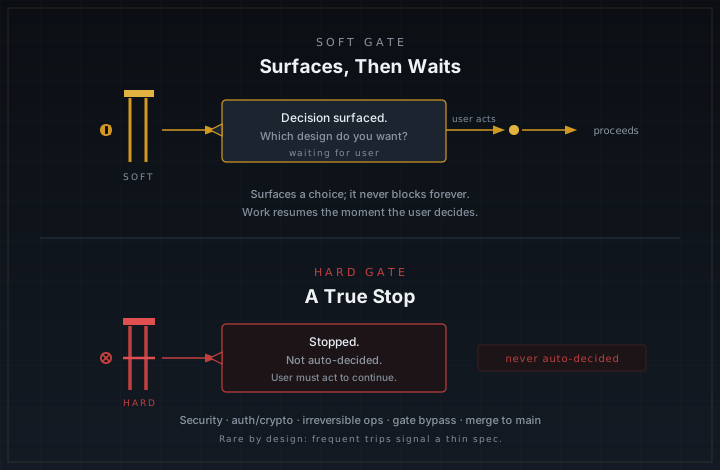
Gates come in two strengths. Soft gates surface a decision and wait for the user. Hard gates are true stops, never auto-decided, even under autonomous execution: anything in the security controls, auth/crypto/secret changes, irreversible operations, a gate bypass, an unresolved decision, or a merge to the default branch. Hard gates are rare by design; a hard gate that trips often is a signal the spec was too thin, and worth fixing at the spec rather than working around at the gate.
How many gates, concretely
Section titled “How many gates, concretely”Lane depth is scaled to risk. The tdd skill runs 6 gated phases:
obligation scan, red, green, obligation verify, coverage, lint. The
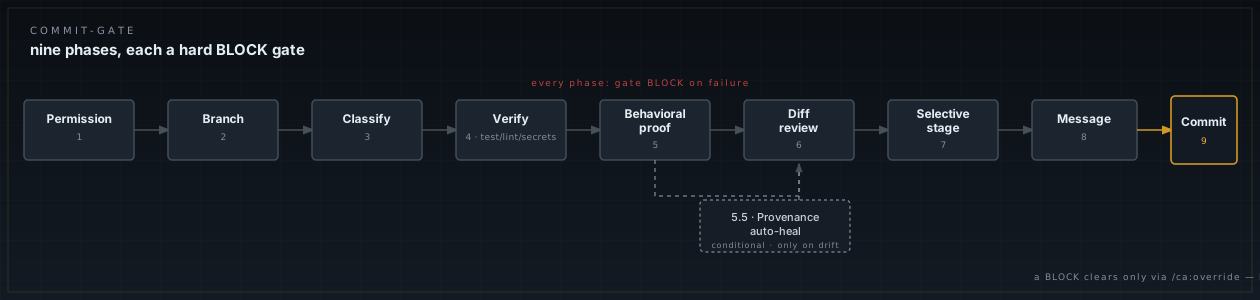
commit-gate skill runs 9: permission, branch,
classification, verification, behavioral proof, diff review, selective stage, message,
commit. It’s the only path to a commit. refactor runs 6
phases, all built around proving behavioral parity through unmodified pre-existing tests.
Mandatory routing at commit time
Section titled “Mandatory routing at commit time”A change that touches certain surfaces pulls a specialist reviewer into the lane automatically, not by request:
- Crypto-compliance and secret-handling changes must mint a digest-bound
security-gate-passedmarker before commit-gate lets the commit through; hooks H-09b and H-10b block it otherwise. - A database migration must mint
migration-gate-passed, enforced by H-14. - A CI or deploy-path change dispatches
security-reviewer, enforced by H-15/H-16, though advisory rather than blocking.
See the hooks and gates reference for the full gate catalog.
The terminal lane
Section titled “The terminal lane”Every change lands through a PR, via finishing-a-development-branch. Direct merge to the default branch is forbidden.
The one sanctioned way around any of this is /ca:override:
a deliberate bypass that appends one line to overrides.log and proceeds. It is logged, not
silent.