
Cut a Release
/ca:release is the only permitted path to a version tag. It derives the SemVer bump from Conventional Commits history since the last ca tag, updates CHANGELOG.md, composes an annotated tag locally, and publishes a GitHub Release only after you explicitly authorize it.
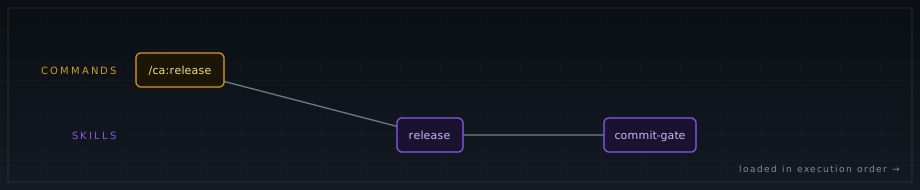
/ca:release lane by piece type: command (gold) and the skills it routes through (violet), each loaded in execution order.Prerequisites
Section titled “Prerequisites”Four conditions must hold before /ca:release will proceed:
- On a feature branch. The current branch must not be the default branch (
main,master, or equivalent). Releases land through the normal branch-and-PR path; if HEAD is the default branch, the release stops immediately. - Clean working tree. No uncommitted changes. Commit or stash through
/ca:commitfirst. - Green suite. The last suite run must have passed. A red suite blocks tagging.
- No open CONFIRM blocks. Any unresolved
[CONFIRM-NN]block stops the release.
Every feat and fix commit in the release window must carry a CHANGELOG: footer. A commit missing that footer is a hard block. The skill never auto-fills one.
CHANGELOG: Footer Format
Section titled “CHANGELOG: Footer Format”The CHANGELOG: footer is part of the commit body, following the Conventional Commits trailer convention:
feat(release): resolve baseline tag through tested helper
CHANGELOG: Tag derivation now resolves the ca baseline tag through the tested helper, excluding pre-releases and ca-sandbox tags.
/ca:release rolls these footers into the new changelog section. If a feat or fix commit has no footer, it surfaces the commit and stops.
Check Readiness Without Tagging
Section titled “Check Readiness Without Tagging”Before running the full release, use --dry-run to see the bump classification and the commit window:
/ca:release --dry-runThis runs every gate and surfaces a readiness report. It stops before composing the tag. Use it to confirm the derived version and the commit set look correct before proceeding.
--dry-run combines with an explicit version:
/ca:release "X.Y.Z" --dry-runRun the Release
Section titled “Run the Release”/ca:releaseNo version argument means --auto: the version is derived from the commit log. Supply it explicitly when you need a specific version:
/ca:release "X.Y.Z"An explicit version that disagrees with what the commit log requires is a hard block. The bump is never silently adjusted. An explicit version and --auto are mutually exclusive.
Phase 1: Version and CHANGELOG
Section titled “Phase 1: Version and CHANGELOG”The skill reads every plugins/ca/-scoped commit since the last ca SemVer tag. Commits under plugins/ca-sandbox/ do not affect the bump or the changelog. The highest-precedence type in the window determines the bump:
| Highest-precedence type in the window | Bump |
|---|---|
BREAKING CHANGE: footer or ! after type/scope | major |
feat | minor |
fix, perf, or refactor | patch |
test, docs, chore, or ci only | no bump; nothing to release |
The CHANGELOG: footers from feat, fix, and perf commits are appended to CHANGELOG.md under a new Keep-a-Changelog heading:
## [X.Y.Z] — YYYY-MM-DD
### Added- ...
### Fixed- ...
Prior sections stay intact. If CHANGELOG.md does not exist, the skill creates it. The README version badge, command/skill/agent count badges, and the COMMANDS.md catalog are also updated to match the repo. If those changes require a commit before tagging, it routes through commit-gate.
Phase 2: Tag
Section titled “Phase 2: Tag”The annotated tag is composed locally from the Phase 1 changelog section. The tag is never pushed without authorization. Phase 2 ends with a report: version, bump rationale, per-commit classification, the new changelog section, and the tag SHA.
Phase 3: Publish (Requires Authorization)
Section titled “Phase 3: Publish (Requires Authorization)”The tag and GitHub Release publish together, and only after you authorize them. Without authorization, nothing leaves the local repository.
Review and Authorize
Section titled “Review and Authorize”Read the Phase 2 report. When the version, classification, and changelog section look correct, authorize publication.
On authorization:
- The tag is pushed to the remote.
- A GitHub Release is created. The notes are the Phase 1 changelog section verbatim; they are never re-derived or hand-written.
- The Release is read back via
gh release viewto confirm it is non-draft and on the correct tag. Ifghis unavailable or the call fails, the skill surfaces the exact manual command so you can finish publication by hand rather than leave it in an incomplete state.
The Release URL is reported only after the read-back confirms a non-draft Release on the correct tag.
Common Blocks
Section titled “Common Blocks”| Situation | Effect | Resolution |
|---|---|---|
A feat or fix commit has no CHANGELOG: footer | Phase 1 stops; the commit is surfaced | Add the footer to the commit; re-run |
| Explicit version disagrees with the commit log | Hard block | Use --auto or supply the correct version |
| Suite is not green | Pre-flight stops | Fix the failing tests; re-run |
Window is non-bumping (test/docs/chore/ci only) | Phase 1 stops | Nothing user-visible to release |
| Dirty working tree | Pre-flight stops | Commit or stash via /ca:commit |
| HEAD is on the default branch | Pre-flight stops | Switch to a feature branch |
Any block may be bypassed only through /ca:override.
Related
Section titled “Related”- release command reference: arguments and hard gates
- release skill reference: full phase-by-phase specification